
Substance use disorders among adolescents is a pressing public health concern. Residential treatment is a vital health care service for adolescents, but there is little publicly available information about how programs function, their costs, and how readily they can be accessed, especially among private programs. This study where members of the research team reached out to programs as “secret shoppers”, (i.e., pretended to be “shopping” for adolescent residential treatment) documented these key pieces of information about adolescent residential treatment across the U.S.
WHAT PROBLEM DOES THIS STUDY ADDRESS?
Adolescence is a time marked by many important neurological, physical, and social changes that are impacted by substance use. Substance use during this developmental phase can escalate from experimentation to problematic use associated with immediate and long-term consequences. For example, adolescents are at greater risk for severe substance-related harms including increased risk for violence, sexually transmitted infections, suicide, and substance-related mortality (e.g., overdose, drunk driving). Developmental milestones and transitions like high school graduation and work force entry can also be complicated and delayed due to problematic substance use. Comorbidity and polysubstance use among adolescents who use substances are also high. Additionally, adolescent overdose deaths are on the rise. In 2020, overdose deaths increased 94% from 2019, and deaths increased another 20% from 2020 to 2021. Overdose deaths attributable to fentanyl have had the most dramatic increase with rates four times that of other substances in 2021.
Residential treatment is a vital health care service in the continuum of care for adolescents. Adolescents who go to treatment typically fare better than those that do not. For example, the Treatment Outcome Perspectives Study (TOPS) showed that adolescents who attended residential treatment had positive behavioral changes, even after treatment. The Drug Abuse and Treatment Outcomes Study for Adolescents (DATOS-A), similarly, found that adolescents who attended residential treatment were less likely to report substance use and serious illegal activity. The Adolescent Treatment Models initiative, a 10-site, multimodality, prospective study, also found that those who attended residential treatment, compared to other treatments (e.g., outpatient), had the largest reductions in substance use. Despite, these large, federally funded studies, there is limited detail on the cost, availability, and types of adolescent residential treatment services across the U.S.
Overall, residential treatment can be challenging to locate, and programs can be even harder to evaluate. Previous research has found that many adolescent treatment settings infrequently provide evidence-based care to adolescents, such as buprenorphine for adolescents with opioid use disorder. Yet, very little is known about the availability, cost, or marketing practices of adolescent residential treatment in the U.S. This study sought to identify adolescent residential treatment facilities in the U.S. and document their availability and cost.
HOW WAS THIS STUDY CONDUCTED?
In this descriptive study, the research team called 354 residential adolescent treatment facilities posing as aunts and uncles of a 16-year-old niece or nephew with an opioid use disorder in an approach called a secret shopper study. The method approximates the real-world experiences of individuals and families seeking treatment and can help identify health care inequities. This study was based on a previous study of adult residential treatment facilities. The process consisted of identifying residential adolescent treatment facilities, engaging in a scripted dialogue with the facility representative pretending to seek treatment for a niece/nephew, and carefully documenting the call. First, the research team identified facilities through the Substance Abuse and Mental Health Services Administration’s (SAMHSA) treatment locator and a third-party website—SpyFu—that provides access to Google advertising data that can be searched for key words (e.g., “adolescent addiction treatment”).

Next, the researchers developed a structured call script and data collection tool to garner information about admission, treatment practices, and costs. Then, from October 24th through December 20th, 2022, the study team called each identified facility while role-playing as the aunt or uncle of a sixteen-year-old child with a recent nonfatal fentanyl overdose. The child was said to be uninsured but likely eligible for Medicaid, which facilitated questions about accepting uninsured adolescents and how families typically covered the cost if they did. Whether the facility did accept Medicaid was also asked. The callers also inquired about whether a program spot was available (wait time and approval process), cost (cost per day, accepted self-pay payment forms, and up-front costs), and if they offered buprenorphine. Whether the facility was for-profit, non-profit, and accredited by either the Joint Commission or the Commission on Accreditation of Rehabilitation Facilities was also documented. Last, the study team aggregated findings to the state-level and used descriptive statistics to evaluate residential adolescent treatment availability and costs.

Through the SAMSHA treatment locator and SpyFu, the researchers identified 354 residential adolescent treatment facilities. Of those, the researchers were unable to speak with 27 due to nonworking or incorrect phone numbers provided to SAMHSA or no one answered after five call attempts.
Out of the 327 facilities reached, only 160 confirmed that they provided residential treatment for those under the age of 18. The average minimum age of patients seen with was 13 while the average maximum was 18. Among those, 106 (66%) only offered treatment to adolescents, 44 (28%) also saw adult patients but housed them separately, and 10 (6%) treated adults and housed them with adolescents. There were 66 (41%) for-profit and 94 (59%) non-profit facilities, with 53 (33%) accredited by the Commission on Accreditation of Rehabilitation Facilities and 66 (41%) by the Joint Commission.
WHAT DID THIS STUDY FIND?
Less than half of the adolescent residential treatment facilities had an immediate spot available
Out of the 66 for-profit facilities, 51 (77%) had a spot available that day compared to 36 out of 94 (39%) of non-profit facilities. The average estimated time until a spot opened up among facilities without day-of availability was 28 days, with 11 (17%) facilities estimating an opening within the week. The average wait time was longer at non-profit vs for-profit facilities (31 days vs 19 days). The longest wait time at a non-profit facility was 180 days, while the longest at a for-profit was 35 days. Out of all facilities contacted, 57% of those that accepted Medicaid reported a waitlist, compared to 19% of facilities that did not accept Medicaid.
Many adolescent treatments facilities do not accept Medicaid
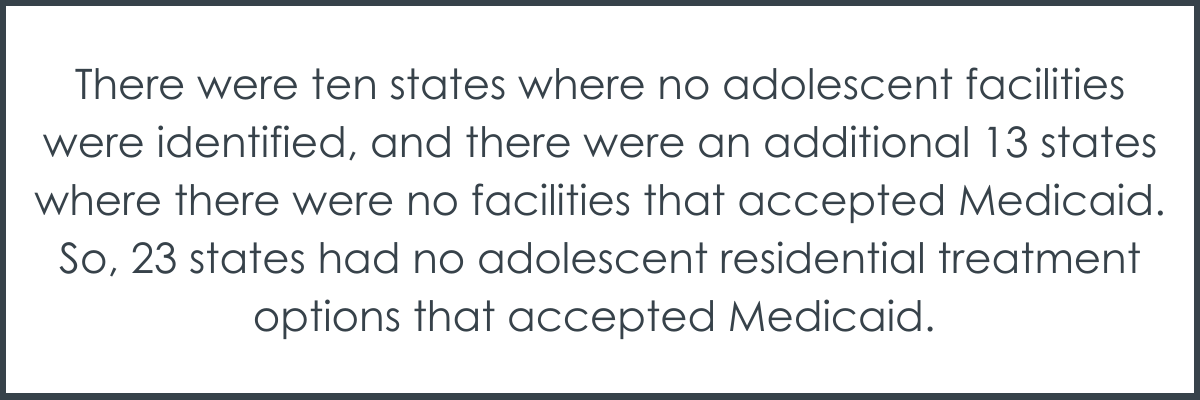
Only 91 (57%) adolescent residential treatment facilities accepted Medicaid. Among for-profit facilities, 20% accepted Medicaid. In contrast, 83% of non-profits accepted Medicaid. There were ten states where no adolescent facilities were identified, and there were an additional 13 states where there were no facilities that accepted Medicaid. So, 23 states had no adolescent residential treatment options that accepted Medicaid.
For-profit programs had higher daily costs than non-profit programs
Average daily costs per day at for-profits were 3 times that of non-profits. There were 126 facilities out of the 160 that accepted cash payments, including all the for-profit facilities. Among those facilities that took cash payments, 108 shared estimated costs. The average cost per day of treatment was $878, with a median cost of $513 per day. Costs per day were higher at for-profit facilities compared to non-profit facilities ($1,211 vs $395).
Up-front costs were high, especially at for-profit facilities
The average reported up-front cost for adolescent residential treatment was $28,731. Of the 160 facilities contacted, 76 (48%) required some up-front payment if using self-pay. Among for-profit facilities that required an up-front payment, the average up-front payment was $34,729. At non-profits, the average up-front cost was $9,897.
WHAT ARE THE IMPLICATIONS OF THE STUDY FINDINGS?
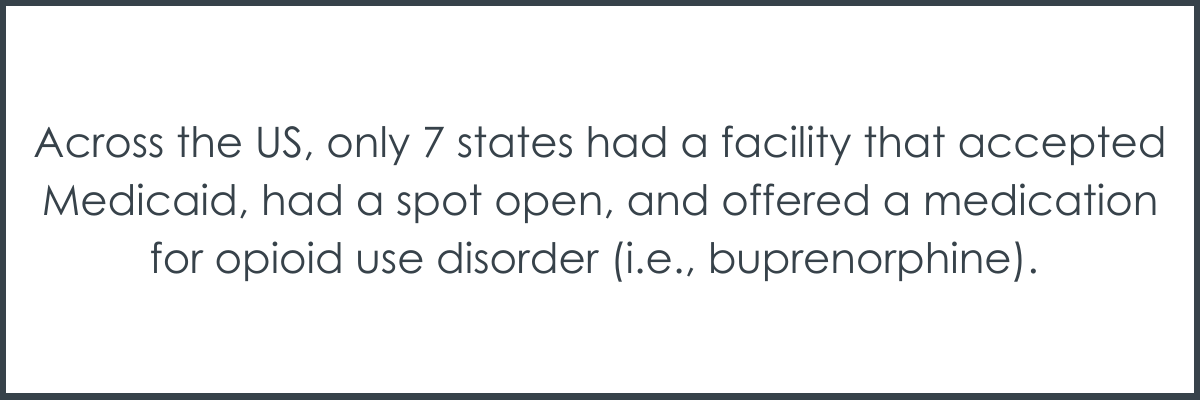
The current study provides evidence that adolescent residential treatment in the US is limited and costly. In 23 states there were no adolescent residential treatment facilities that accepted Medicaid. Only 7 states had a facility that accepted Medicaid, had a spot open immediately, and offered buprenorphine. These findings are of particular importance because of the increasing overdose death rates among adolescents.
Residential treatment is one aspect of the larger continuum of care for adolescents, which also includes mutual-help organizations (e.g., Alcoholics Anonymous, Narcotics Anonymous, SMART), outpatient treatment, and primary care. Timely access to the appropriate level of care along the continuum is necessary to curtail the rising overdose deaths and limit substance use careers along with their related harms. This study has identified residential treatment to be highly variable, with stark contrasts between non-profit and for-profit facilities. Enhancing services, such as providing access to medications for opioid use disorder, and increasing availability, like ensuring more open spots, while concurrently lowering costs, presents a significant challenge but is likely essential for effectively supporting adolescents who misuse substances. Identifying which adolescents would benefit the most from residential treatment would also help prioritize health care cost for individuals, families, and communities. Additionally, creating payment models that ensure equitable, high-quality care will likely play a crucial role. This issue extends even to private insurance plans, which were not examined in this study yet play an integral role in determining treatment among those insured.
Improving availability and addressing inequitable treatment access is one piece of the puzzle. Adolescent primary care and outpatient services can also be strengthened to support adolescents with substance use problems, especially where there are few if any residential facilities. Increasing the frequency of substance use screenings during primary care visits, for example, may help identify adolescents that need additional care. Additional training could also be provided to primary care physicians to increase their knowledge of and comfort with medications for substance use disorders (e.g., buprenorphine). Across all points of care along the continuum, better partnership practices and communication between facilities and providers would likely increase the chances that an adolescent receives the on-going support they need when they need it.