
Young adults drink more heavily than any other age group but are the least likely to seek treatment. Large language model (LLM) chatbots, such as ChatGPT, may make knowledge and support more accessible. This study pilot tested an LLM-based chatbot trained to deliver motivational interviewing for alcohol-related behavior change among young adults, evaluating its safety, acceptability, and fidelity to motivational interviewing principles.
WHAT PROBLEM DOES THIS STUDY ADDRESS?
Young adults (ages 18-25) engage in the highest levels of alcohol use of any age group but have the lowest levels of treatment engagement. Barriers like low perceived need, stigma, time constraints, cost, reluctance to fully abstain, and limited access to providers often prevent individuals from seeking traditional, in-person care. Low-threshold and familiar digital tools may help bridge this gap by offering more easily accessible, private, and flexible options for young adults to reflect on and self-manage their alcohol use.
Many digital alcohol interventions – such as text messaging programs, web-based platforms, smartphone apps, and rule-based AI chatbots (which use pre-defined rules and scripts) – have been developed and clinically tested. These tools have consistently demonstrated modest but robust effects on reducing alcohol use, which, given their low cost and reach, could make a significant public health impact. However, most AI chatbots to date operate on aforementioned rule-based systems with pre-scripted responses, which limits their ability to understand users’ individual contexts and provide personalized, adaptive interactions. These limitations have led to mixed engagement outcomes – particularly when chatbots are unable to respond to unanticipated user inputs that were not specifically scripted for by the researchers, resulting in high dropout rates during conversation sessions. The emergence of generative artificial intelligence (AI), particularly large language model (LLM)-based chatbots like ChatGPT, introduces new possibilities for delivering more dynamic, personalized, and human-like digital support.
While LLMs like GPT-4 have been shown to provide accurate responses to alcohol and other-drug related prompts and have demonstrated early promise in mental health applications, their potential for delivering direct alcohol counseling remains largely unexplored. This pilot study aimed to fill that gap by developing a secure LLM-based chatbot trained to deliver motivational interviewing for alcohol-related behavior change in young adults, and evaluated whether the chatbot could do so safely, acceptably, and in alignment with motivational interviewing standards.
HOW WAS THIS STUDY CONDUCTED?
This was a 2-phase, single-arm pilot study testing a GPT-4 powered chatbot with specialized training in motivational interviewing for alcohol-related behavior change. Participants (N = 45) were ages 18-25 (Mean age = 23.6 years), reported consuming at least 10 standard drinks per week, and engaged with the chatbot during a single session. After initial testing in Phase I (n = 8), the researchers refined the chatbot based on feedback and tested the updated version in Phase II (n = 37). The study sample was predominantly white (66.7%), male (71.1%), and college-educated (82.2%) with an average AUDIT score of 7.6, indicating moderate alcohol use severity.
The researchers developed their motivational interviewing chatbot by using Open AI’s GPT-4 and further refined the chatbot through prompt engineering and domain-specific fine-tuning to enhance alignment with motivational interviewing principles. The chatbot was securely hosted on university servers using HIPAA-compliant infrastructure to ensure participant privacy and data protection.
To train the chatbot, the researchers used a publicly available dataset of counseling dialogues coded for motivational interviewing fidelity, extracting 134 alcohol-related sessions to identify relevant high-quality client-therapist exchanges. These were used to refine the chatbot’s responses through iterative prompt development and qualitative review. They then generated 20 synthetic conversations using GPT-4 seeded with anonymized data from a prior clinical trial involving young adults with heavy episodic drinking, to test and validate the chatbot’s consistency before deploying to participants.
Participants were recruited via an online crowdsourcing platform. After providing informed consent, they completed a baseline survey (demographics, motivation to change, and alcohol use severity), interacted with the chatbot, and completed a post-interaction survey assessing usability (System Usability Scale; e.g., “I thought the system was easy to use”) and motivational interviewing fidelity (Client Evaluation of Motivational Interviewing; e.g., “The counselor seemed to understand how I see things;” “The counselor helped me see how my behavior fits with what I want in life”). Participants were told they could interact with the chatbot as much or as little as they wanted. They were also invited to share open-ended feedback on their experience communicating with the AI chatbot about their alcohol use.
Primary outcomes included usability and motivational interviewing fidelity. The authors also analyzed transcripts for safety concerns, intervention fidelity, and coded sessions for change talk versus sustain talk – motivational interviewing terms used to denote speech that is characteristic of changing one’s drinking versus not changing one’s drinking, respectively. Outcomes were compared between Phases I and II to assess whether prompt refinements led to improvements in chatbot performance.
WHAT DID THIS STUDY FIND?
The chatbot was safe and highly acceptable to young adults
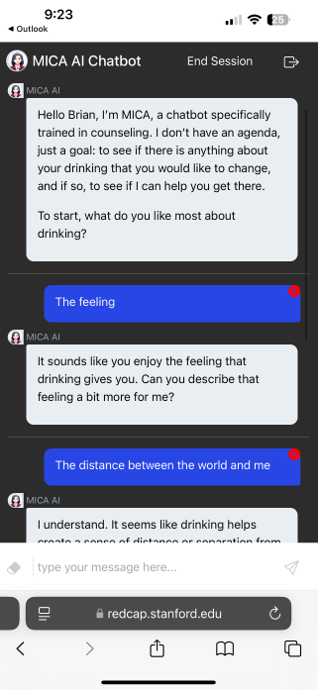
No inappropriate or unsafe responses were identified in transcript reviews. Usability scores were high, with participants rating the chatbot 85.4 out of 100 in Phase I and 80.9 in Phase II on the System Usability Scale (higher than the benchmark of 68 set by the research team). Qualitative feedback highlighted that the chatbot was helpful for reflecting on drinking habits, setting realistic goals, and exploring strategies for positive change. Participants also described the chatbot as convenient and easy to use.
(Image Source: Suffoletto, 2025)
Engagement was moderate, with mixed reviews on conversational quality
On average, participants engaged with the chatbot for 6 minutes in Phase 1 and for 11 minutes in Phase II. The number of participant responses per session dropped slightly from 15 in Phase I to 13 in Phase II. Feedback on the chatbot’s conversational style was mixed – some individuals found it natural and emotionally supportive, while others felt its responses were formulaic or lacked personalization.
The chatbot demonstrated high motivational interviewing fidelity and elicited change talk
Motivational interviewing fidelity improved after model refinements between Phase I and II. Relational subscale scores on the Client Evaluation of Motivational Interviewing increased significantly from 67.2 in Phase I to 82.6 in Phase II. Technical subscale scores also improved from 69.6 in Phase I to 81.3 in Phase II. These Phase II scores outperformed the benchmark of 80 set by the research team. The chatbot elicited a high proportion of within-session change talk – rising from 65.2% in Phase I to 75.8% in Phase II. Although these latter two differences were not statistically significant, statistical significance can be difficult to reach in small pilot study samples like these. Overall, these differences appear to be meaningful.
WHAT ARE THE IMPLICATIONS OF THE STUDY FINDINGS?
This study found that a large language model (LLM)-based chatbot, specifically trained in motivational interviewing for alcohol-related behavior change in young adults, was safe, highly acceptable, and demonstrated strong fidelity to motivational interviewing principles. Participants valued the chatbot’s convenience, ease of use, and usefulness in promoting self-reflection, goal setting, and strategy development for behavior change. Some described their chatbot interaction as natural and supportive. However, others reported that the chatbot’s responses felt formulaic and impersonal, which may have contributed to relatively limited engagement. Still, with careful development and thorough validation before deployment, LLM-based chatbots may be capable of delivering motivational interviewing-based alcohol counseling with fidelity – potentially offering a scalable and accessible means of encouraging positive alcohol-related behavior change.
These findings contribute to a growing body of research suggesting that generative-AI based chatbots may hold promise in the substance use field, including as tools for delivering behavioral interventions. However, it remains unclear whether engaging with an LLM-based chatbot trained in motivational interviewing can lead to actual reductions in alcohol use.
In this study, participants interacted with the chatbot for only 6-11 minutes on average across the two phases – raising questions about whether such tools can sustain user engagement long enough to produce meaningful behavior change. Future studies should use randomized controlled designs to evaluate whether this and similar LLM-based chatbots trained in alcohol intervention are as effective as – or more effective than – straightforward alcohol use tracking, as well as existing digital tools or in-person interventions. Enhancing the personalization and engagement capabilities of AI chatbots may also be critical for sustaining user interaction and supporting long-term behavior change. Additional research should also explore how LLM-based chatbots can complement traditional care – for example, by offering support between therapy sessions or providing access during times when clinicians are unavailable, such as evenings and weekends. If shown to be effective, LLM-based chatbots could offer a scalable solution for reaching young adults – a group that has historically been less likely to engage with conventional alcohol treatment compared to other age groups.