

Alcohol use and aggression in young people can lead to severe consequences, including emergency room visits. This study recruited young people presenting in emergency departments and tested whether additional treatments can improve on an established brief intervention for alcohol use and aggression.
WHAT PROBLEM DOES THIS STUDY ADDRESS?
Underage alcohol use is linked to disruptions in typical neurological development, a higher risk of developing alcohol use disorder later in life, and acute harms such as injuries, sexual assault, overdose, motor vehicle accidents, and death. Alcohol is also considered to be the most harmful substance to other people (e.g., assaults, domestic violence). In parallel, youth aggression also contributes significantly to public health concerns. For youth ages 15-19, homicide was the second leading cause of death in 2021. Thus, interventions for youth that lead to reduced alcohol use and aggression may have a meaningful individual and societal impacts.
A range of interventions have been shown to help reduce alcohol use among youth though many do not willingly attend treatment. Furthermore, typical programs taking several sessions can be costly and may not be feasible for many young people. Brief interventions—often delivered in a single session—are promising strategies that save resources, scale easily, and may improve outcomes. Incorporating technology and adaptive design elements may further enhance the effectiveness of these brief approaches without substantially increasing costs. For example, strategically allocating resources to individuals with the greatest need (i.e., adapting), assessed at multiple timepoints, may improve efficiency and support broader scalability. This study explored if adaptative boosters following a brief intervention for young people reporting to the emergency department had a differential effect on alcohol use and aggression.
HOW WAS THIS STUDY CONDUCTED?
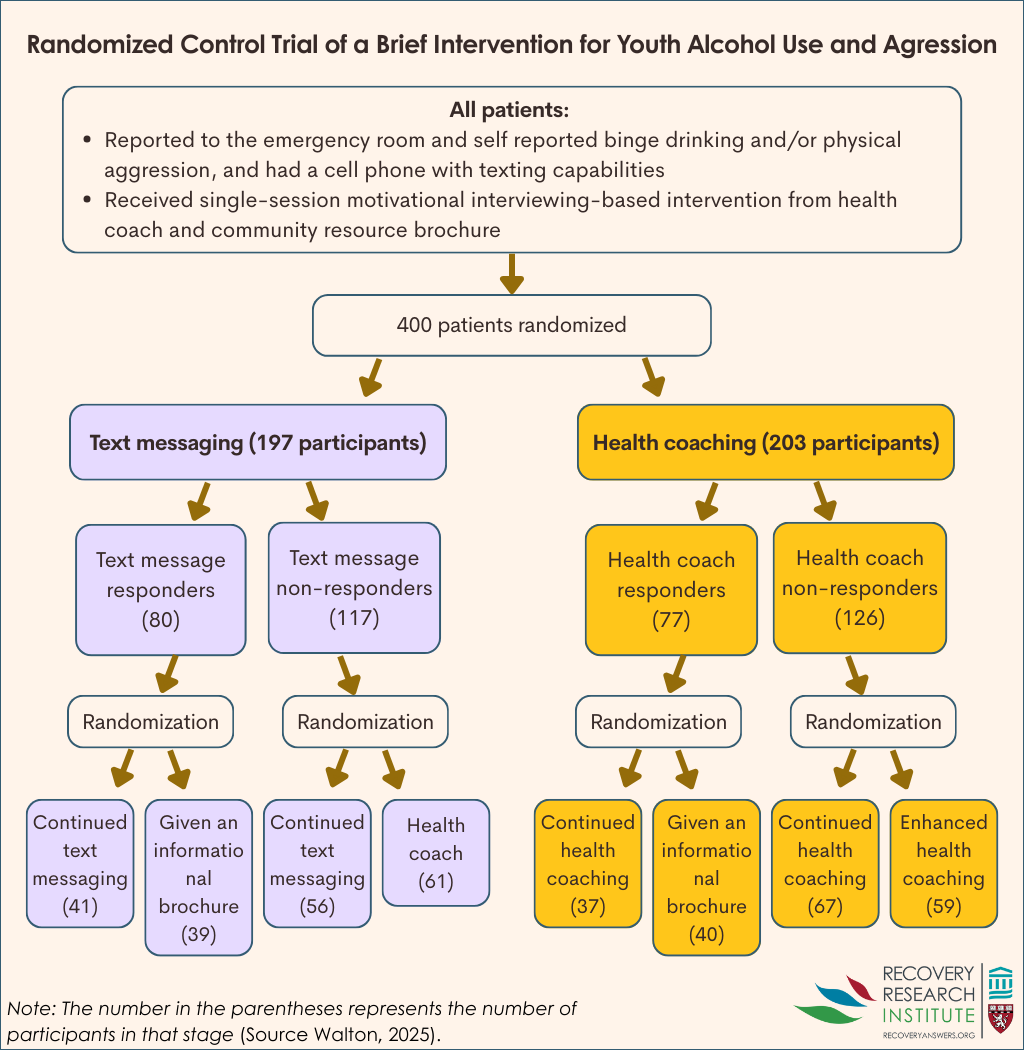
This study was a sequential multiple assignment randomized trial among 400 youth (aged 14-20) that reported to the emergency department for any reason except sexual assault, child maltreatment, or suicide attempt/ideation. Youth who self-reported binge drinking (via the AUDIT-C assessment), physical aggression, and a cell phone with texting capabilities were eligible for the study. Following the initial baseline survey and enrollment, youth received a brief intervention followed by an 8-week sequential multiple assignment randomized trial (see graphic below for details). Then outcomes were measured at 4- and 8-months post brief intervention.
In this study, the sequential design featured two 4-week stages with weekly surveys and two primary booster conditions. The main aim of this study was to explore if changing the booster condition after 4-weeks impacted the intervention outcomes, which could suggest the efficiency of adapting resource allocation (e.g., more and less) at multiple timepoints to improve outcomes for youth.
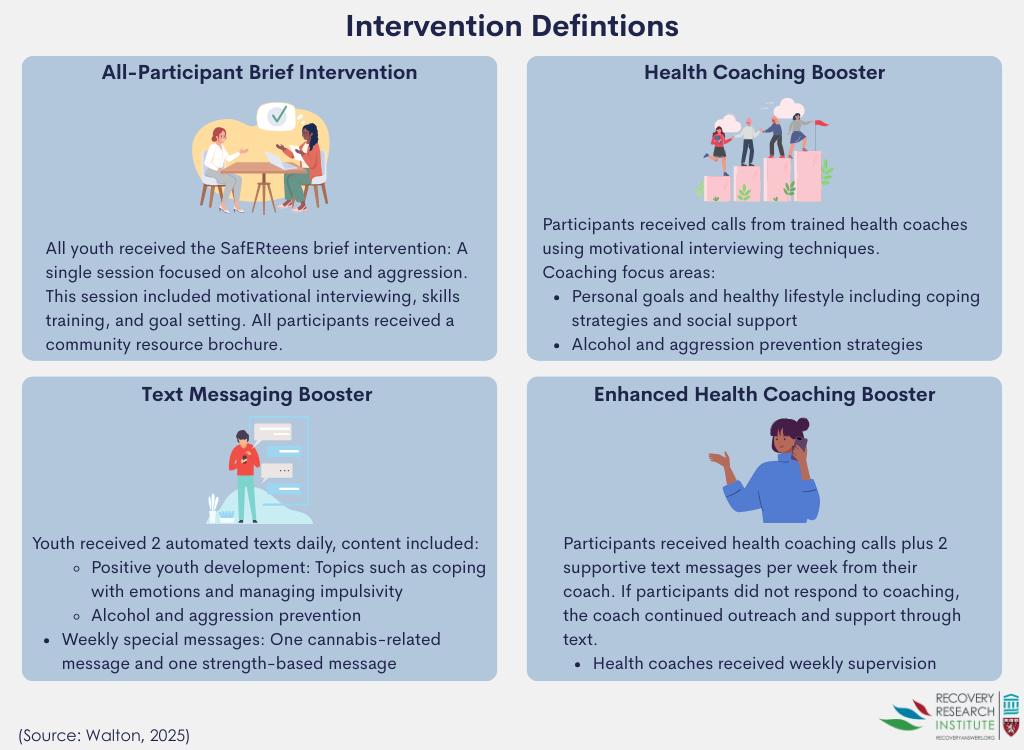
All youth received the SafERteens single session brief intervention for alcohol use and aggression, which combines motivational interviewing and skills training. The brief intervention (averaging 32 minutes in this study) includes goal setting, tailored feedback, decisional balance exercise, role plays, and referrals. See graphic below for intervention details.
After the brief intervention, the participants received boosters: text messaging, telehealth calls from a health coach, both texts and telehealth calls, or a resource brochure. For the text messaging booster, youth received automated texts twice per day. The automated texts were pulled from a library of about 1200 possible texts that were created with feedback from youth advisors. Morning texts (10am-3pm) featured positive youth development messages related to coping with negative feelings, impulsivity, excitement, social support, hope, and leisure activities. Afternoon texts (4-9pm) featured reasons and tools to avoid or reduce alcohol use and aggression. One day per week included a cannabis-related message, and one day included a strength or positive quality that the youth participant had identified themselves in the prior weekly survey. The health coaching condition included calls from a trained health coach and featured motivational interviewing focused on personal goals and healthy lifestyles with strategies to avoid alcohol and aggression incorporated when possible.
The graphic below outlines how participants flowed through this multi-stage study. At the first stage, youth were randomly assigned to either receive the text messaging or health coach call. After the first 4-weeks, youth were identified as intervention responders or non-responders. Response status was determined by self-reports on the week 3 and 4 surveys. “Responders” were those who reported no binge drinking or aggression, and “non-responders” were those who reported binge drinking, aggression, both, or did not complete the survey.
At the second stage, responders were randomized to receive either the same condition (i.e., booster) or a minimized condition (health coach to texts or texts to resource brochure). Non-responders were re-randomized to receive either the same or an intensive condition (e.g., text messaging stepped up to health coach; health coach stepped up to health coach plus text messages). This 2-stage process results in 8 possible groups.
The first analysis compared texts versus heath coaching after the first 4-week stage on 4- and 8-month outcomes. The next group of analyses assessed responders and non-responders separately on 8-month outcomes accounting for the 4-month outcomes, age, and sex. The last group of analyses looked at overall changes from baseline to 8-month follow-up. The two primary outcomes were past 30-day alcohol use and past 30-day aggression, which could be toward friends, neighbors, relatives, acquaintances, dating partners, or strangers. Aggression was then made into a yes/no variable because it was so rarely reported. Secondary alcohol outcomes included alcohol misuse (yes/no), alcohol consequences, and violence-related consequences. Additional outcomes explored other drug-related measures including drug use severity and drug-related consequences.
There were 400 youth aged 14-20 years (average 18) enrolled in the study. Most of the youth were female (78%), with 51% identifying as Black or African American, 40% White, and less than 10% as another race. Just over half (55%) received public assistance, and 99% were never married. At baseline, the average total number of drinks in the past 30 days was 29, and 52% met AUDIT-C cutoffs for harmful drinking (e.g., score of 3+ in adolescent females). Youth reported 7 alcohol-related consequences, on average. The average days of aggression was less than 1, and the average number of aggression-related consequences was 3. Most youth reported cannabis use (81%), although youth also reported “other illicit drug use” (23%), prescription opioid misuse (15%), prescription sedative misuse (17%), and prescription stimulant misuse (10%).
WHAT DID THIS STUDY FIND?
Booster strategies were equally effective
Outcomes were assessed related to both the first and second stage of randomization. There were no differences in the impact of the text messaging versus the health coaching on reducing alcohol consumption or aggression at the first stage. There were also no differences in alcohol misuse, alcohol-related consequences, aggression-related consequences, other drug use, or other drug-related consequences. Furthermore, the second stage booster strategies for responders and non-responders did not change the effects. For example, for those receiving text messages, adding health coaching did no better than continued text messages. Similarly, there were no differences across all outcomes.
Youth improved over time after receiving the intervention, however
Across all conditions, youth were 4 times as likely to report alcohol abstinence at 4 and 8 months compared to baseline. Among those that did report alcohol use, there was no improvement between baseline alcohol use frequency and the 4- or 8-month follow ups. Youth were nearly 10 times and 15 times more likely to have no alcohol-related consequences at the 4- and 8-month follow up, respectively.
Aggression was less likely at the 8-month follow up, but not the 4-month, compared to baseline. Specifically, participants were about half as likely to report aggression 8 months after the brief intervention. Other drug use apart from alcohol, other drug-related consequences, and aggression-related consequences were also less likely at the 4- and 8-month follow ups compared to baseline.
While these improvements are noteworthy, all individuals in the study received the brief intervention and there was no real non-treatment condition (although the type and intensity of texting and health coaching did vary across time). Consequently, we can’t know with certainty whether such improvements would have happened anyway without this intervention.
WHAT ARE THE IMPLICATIONS OF THE STUDY FINDINGS?
This study did not find that adding either daily text messages or adding calls from a health coach improved outcomes when added to a brief intervention delivered in the emergency department. Furthermore, among those who did not have a positive response, outcomes were similar for more (e.g., texting to health coach calls) and less intense (e.g., texting to resource brochure) boosters. Overall, boosters did not differentially change the impact of the intervention on alcohol, aggression, or other drug outcomes. This could be good news: automated text messages were as effective as a live health coach phone call. That said, the study did not include a comparison group that received no booster, so it remains unclear whether boosters themselves led to improved outcomes.
Also, on average, over the course of the study youth had lower odds of alcohol use, aggression, alcohol consequences, and violence consequences at both the 4- and 8-month follow ups compared to baseline. While there was no non-treatment control group in this study to enable the researchers to conclude that the brief intervention was responsible for the large observed benefits, a prior version of the study, comparing this same brief computerized intervention to a control resource brochure condition, did show the intervention was beneficial especially when a therapist facilitated its delivery.
More research is needed to disentangle the effects of the brief intervention and booster sessions, so that this empirically-supported approach to address youth alcohol use and aggression can be scaled in as cost-efficient manner as possible. It may be that certain youth may prefer or respond better to different types of approaches, but this was not examined in this study.
Of note there may have been a selection bias in the included study sample as most youth ED visits for alcohol/drug related aggression are male and almost four out of five study participants here were female. Though it is unclear why females were overrepresented, this unusual aspect of the study suggests results may have been different with more males represented and included in the study.