
For people with history of legal system involvement, colleges may increase employment opportunities and reduce recidivism, making the intersection between collegiate recovery programs and legal systems an important one. This study helped illuminate the characteristics and needs of collegiate recovery program students with history of legal involvement.
WHAT PROBLEM DOES THIS STUDY ADDRESS?
There are 1.9 million people in the US criminal-legal system. There are another 800,000 people on parole, 2.9 million on probation, and at least 79 million with a criminal legal history. Many individuals in the legal system, more than 50% of adults leaving incarceration, have a substance use disorder. Those who have or who go on to earn a college degree fare better after incarceration, with reduced recidivism and higher earnings, yet only 36% of currently incarcerated adults have a college education. Adults with a history of legal system involvement could substantially benefit from more access to college. The “ban the box” campaign calls upon colleges to stop asking about criminal legal history, and the US Congress also recently relaxed restrictions of Pell Grant availability for adults in prison. Both efforts will likely increase access to college. However, few colleges actively recruit or support the needs of students with legal system involvement.
Regarding those with substance use disorder among individuals with current or former legal system involvement, collegiate recovery programs may help provide critical supports. These programs which support college students in recovery from substance use disorders and behavioral addictions provide a suite of services intended to help people build recovery capital while working toward their degree. However, the prevalence of individuals with history of legal system involvement in collegiate recovery settings, and how this history relates to academic, substance use, and recovery outcomes among students is unknown. Knowledge of the characteristics and associated outcomes of those with legal system involvement could inform collegiate recovery and college-level enrollment policies.
HOW WAS THIS STUDY CONDUCTED?
This was a secondary analysis of the National Collegiate Recovery Study, a cross-sectional study that characterizes collegiate recovery program students and their functioning. Participants were recruited from collegiate recovery programs across the US and Ontario, Canda to complete online surveys in Fall 2020, Spring 2021, Fall 2021, and Spring 2022. A total of 425 students from 51 programs completed baseline surveys.
The independent variable of interest in this study is legal system involvement. It was broken into three categories: 1) no history of legal system involvement; 2) history of legal system involvement but without having been incarcerated; and 3) history of legal system involvement including having been incarcerated. Gender (woman, man, and transgender/non-binary/self-identify), race/ethnicity (non-White, White), age, and student status (undergraduate, graduate) were also collected as independent variables. Functioning variables were grouped into four categories: academic/work, quality of life, alcohol and substance use symptoms, and recovery capital. Academic/work functioning included current semester/quarter GPA (0–4.0) and how many hours worked on average per week during the academic year. Quality of life, alcohol and substance use symptoms, and recovery capital were all measured with widely used scales. Alcohol use disorder and other drug use disorder were assessed separately based on DSM-5 criteria based on “the time in the respondent’s life when alcohol or substance use was most prominent”. For drug use disorders, an individual indicated their primary substance other than alcohol. Then, that drug (e.g., opioids) replaced the word “drinking” in the scale. Alcohol use disorder was assessed separately because college students have high rates of alcohol use.
Most students (54%) identified as women, with 28% and 18% identifying as man and transgender/non-binary/self-identifying respectively. Most (82%) students identified as White, and all non-White students were included in a single non-White category. The students were primarily undergraduates (74%). Participants in the three groups were not different by race/ethnicity or student status. Those without history of legal system involvement had a higher proportion of women. Those with legal system involvement but no incarceration reported the highest proportion identifying as man, and those who were formerly incarcerated reported the highest proportion identifying as transgender/non-binary/self-identify or chose not to answer. Participant ages from youngest to oldest were: no legal system involvement were youngest; legal system involvement but no incarceration; and those with history of incarceration. Age and gender were included in analyses to account for the differences in age and gender found across the three groups.
WHAT DID THIS STUDY FIND?
Half of the students in the collegiate recovery program had history of legal system involvement
Of 425 participants, 213 (50%) had no legal system involvement, 117 (28%) were system involved with no incarceration, and 95 (22%) were formerly incarcerated.
Those with a history of incarceration worked more hours per week during the academic year
Collegiate recovery program participants with a history of incarceration reported more hours of work per week during the academic year compared to students with no legal system involvement and those with legal system involvement but no incarceration. Participants with an incarceration history reported an average of 26 hours of work per week during the academic year, while the two other groups reported 14 (non-system involved) and 17 (system involved with no incarceration) hours per week. The effect sizes from this analysis were small, indicating that these differences were subtle.

Student with any criminal legal system involvement reported more substance use disorder symptoms
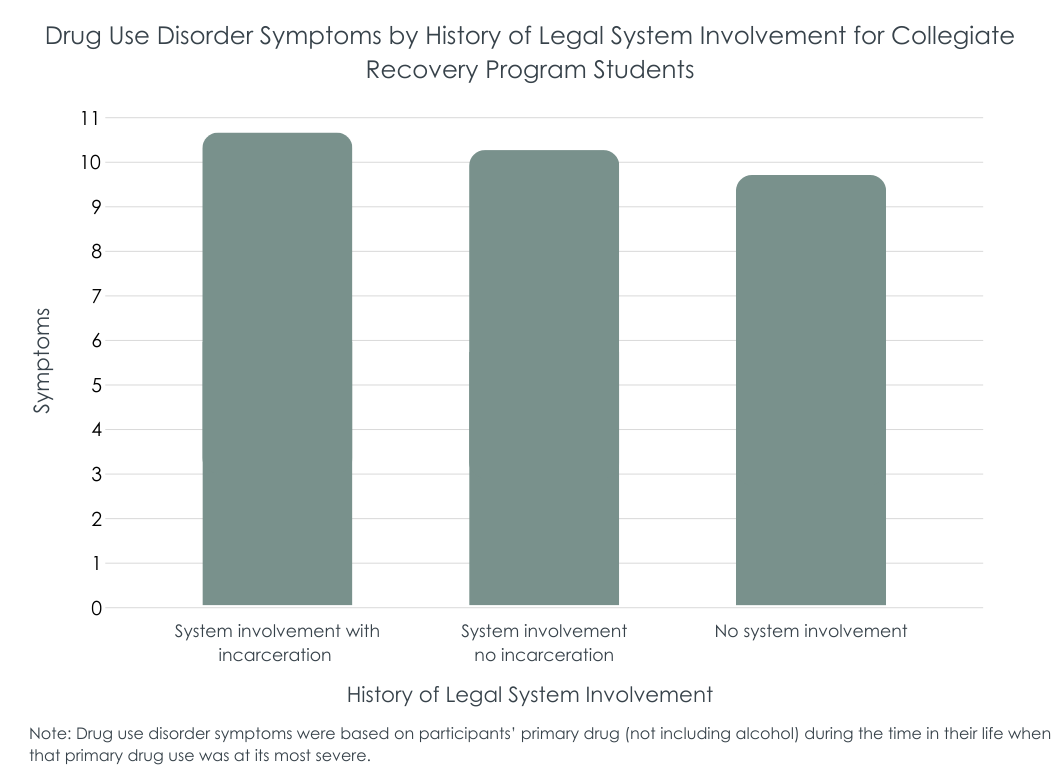
Adults with any legal system involvement (with and without incarceration history) reported more primary drug use disorder symptoms (e.g., opioids) on average when their disorder was most problematic than students with no system involvement. Students in the two legal system involvement groups were not meaningfully different, however. Students in collegiate recovery programs with no legal system involvement reported 9.7 symptoms on average out of 11 possible. Students with legal system involvement but no incarceration reported 10.3, and students with an incarceration reported 10.6 symptoms on average. The effect size from this analysis were moderate, which indicates that the differences between groups were noticeable and meaningful but not overwhelming. The three groups had similar alcohol use disorder symptoms.
Students with system involvement had similar GPAs, quality of life, and recovery capital
After accounting for differences in gender and age, legal system involvement groups, with and without incarceration, were similar to those without legal involvement history on GPA, quality of life, and recovery capital. All groups reported a 3.5 GPA on average. Students in all three groups reported 30–32 out of 40 on the quality of life measure, and 51–54 out of 60 on the recovery capital scale.
WHAT ARE THE IMPLICATIONS OF THE STUDY FINDINGS?
Individuals who graduate college typically fare better than those who do not. They earn more money, live longer, engage in less criminal activity, and perform better on cognitive tasks. Many adults do not have a college degree when leaving jail or prison. Collegiate recovery programs aim to help all college students with substance use disorders, and this study found that half of participating students have a criminal justice history. This study is cross-sectional, and thus cannot directly test the effects of collegiate recovery programs on remission status or quality of life and functioning for these individuals. Yet, the high prevalence of students with system involvement suggests that collegiate recovery programs may attract and engage students with these backgrounds and life experiences. The resources collegiate recovery programs provide may be even more important as policy makers continue removing barriers for college enrollment for those with system involvement. Collegiate recovery programs could use this information to tailor their program offerings and expertise (e.g., familiarity with criminal legal system policies).
This study found that any legal system involvement was related to more primary drug use disorder symptoms during the time when perceived to be most problematic (alcohol use disorder symptoms were similar, assessed separately) and that those with an incarceration history tended to work more hours per week during the academic year. Students with an incarceration history likely have more financial needs and would benefit from additional financial support through grants, donor funding, and university support (e.g., scholarships) to enable them to focus on their academic experience. The study also found that GPA, quality of life, and recovery capital did not differ by group, which highlights the strength and resilience of students with a substance use disorder and history of legal system involvement. Students with legal system involvement did report slightly more severe primary drug use disorders, which may indicate greater severity overall and a higher need for support services. Collegiate recovery programs may be a key service for these individuals. However, more work is needed to explore how participating in collegiate recovery programs impacts student experiences and outcomes over time.