

Young adults have the highest rates of non-medical prescription drug use, including opioid painkillers. Public health messaging designed to educate young adults on the potential harms could be a useful public health strategy to reduce risky use and opioid use disorder. This study tested whether a mass media intervention designed specifically for young adults could change knowledge and attitudes about non-medical use of prescription opioids.
WHAT PROBLEM DOES THIS STUDY ADDRESS?
Young adults (ages 18-25) in the US have the highest rates of non-medical use of prescription medications, including prescription painkillers like oxycodone, sometimes referred to as “prescription opioid misuse” but here referred to as non-medical use of prescription opioids. Such opioid use is concerning as it is associated with risks related to intoxication, including but not limited to overdose, while also carrying risk for developing physiological dependence, opioid use disorder, and some may transition to heroin and other opioids that are more likely to be injected, which carries an additional set of risks.
Models of health behavior change suggest that changing knowledge and attitudes underlying the behavior – non-medical use of prescription opioids in this study – will alter related behaviors. In addition, evidence suggests that some young adults hold stigmatizing beliefs about opioid use which is associated with lower treatment engagement among those with an opioid use disorder. This combination of risk for non-medical use of prescription opioids and negative attitudes about people who use opioids make this a uniquely challenging public health problem for this at-risk age group.
At the same time, young adults have the highest rates of digital media use including social media use on sites like YouTube, Instagram, and TikTok; also, many prefer digital streaming platforms like Netflix and Hulu to traditional linear television. Therefore, prevention efforts (e.g., public education campaigns) may leverage young adults’ time spent on digital media to provide psychoeducational content on the risks involved in opioid use as well as efforts to reduce stigmatizing beliefs regarding people who use opioids. To this end, the present study tested the effectiveness of a mass media campaign to change self-reported opioid knowledge and beliefs among young adults living in the US.
HOW WAS THIS STUDY CONDUCTED?
This longitudinal pilot study was designed to investigate the short-term effects of The Truth About Opioids media campaign (see Figure below). This campaign was designed to prevent non-medical use of prescription opioids and opioid addiction among young adults (the target population) through a series of emotionally evocative narratives of young adults whose opioid use and opioid addiction negatively impacted their lives. Narratives included a vivid chronicle of a young woman’s journey through opioid withdrawal and recovery. Each narrative also had a call-to-action prompt for fact exploration and conversations: ‘Know the Truth, Spread the Truth.’ The goal of this call-to-action was to encourage young people to seek out further information on the risks of opioid use and spread it amongst their peers.
To create the campaign narratives, the authors engaged in a process of formative research to identify potential messaging foci using both quantitative and qualitative data. This process included identifying opioid beliefs among young adults, how these beliefs related to opioid use, and the feasibility of impacting young adults’ beliefs/attitudes. This process involved working closely with substance use disorder treatment professionals and people struggling with opioid use disorder.
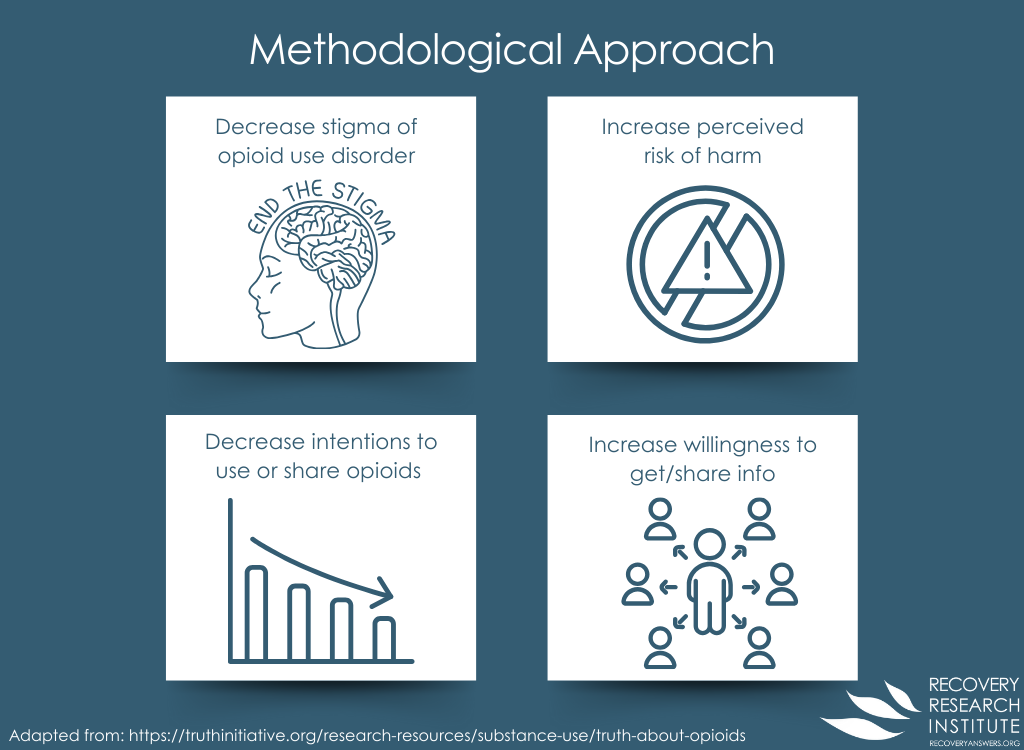
To test the effectiveness of this mass media campaign, a sample of 4765 young adults (ages 18-34) were surveyed both before and after the media campaign aired. Participants were drawn from a commercially available list of cell phone numbers. Participants were restricted to those living in one of 6 areas across 3 states: Fort Wayne, Indiana; South Bend, Indiana; Greensboro, North Carolina; Charlotte, North Carolina; Knoxville, Tennessee; and Memphis, Tennessee. These areas were selected because they had high non-medical use of prescription opioids and overdose rates and limited public health prevention initiatives. Potential participants were sent a text message invitation to the study with a link to complete an online survey. Participants were compensated $10 for completing each survey. All survey procedures were coordinated by a technology service provider and consulting firm used by academic and commercial researchers.
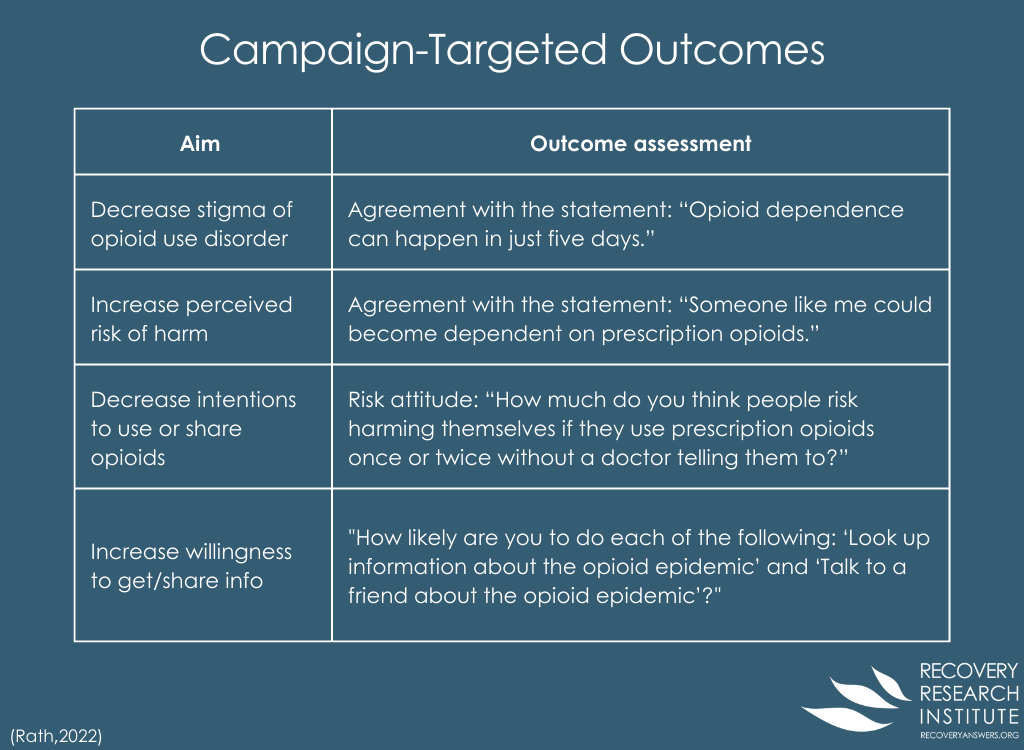
The primary goal of this research was to determine the effectiveness of The Truth About Opioids campaign to increase self-reported opioid use knowledge and beliefs among young adults. Awareness of the campaign was measured by presenting participants with screenshots of the various ads, then asking them, “How many times have you seen one of these ads, or one like it, recently?’ Response options ranged from never (0) to often (3) with responses summed across two sets of screenshots to produce participant awareness scores. These scores ranged from 0-1 (no campaign exposure), 2-3 (low campaign exposure), to 4+ (high exposure). Participants’ knowledge and attitudes about non-medical use of prescription opioids and opioid addiction was measured a series of five-point scales ranging from strongly disagree to strongly agree, which were later dichotomized into binary ‘disagree’ or ‘agree’ categorizations (see Figure below). In addition to the targeted outcomes the study also measured outcomes not expected to change in response to the campaign (e.g., on attitudes toward opioid use disorder medication). This type of strategy is commonly used to bolster the case that a public health initiative like media campaigns was responsible, at least in part, for any observed improvements among those exposed to the campaign.
Analyses that examined change outcomes pre- to post-campaign were weighted to match the local populations of the areas surveyed and controlled for relevant covariates including demographics, their own opioid use as well opioid use in family/friends, current mental health (e.g., depression, anxiety), and county-level overdose rates. Statistical models also controlled for baseline levels of the outcome and thus examined associations between campaign awareness and changes in campaign targeted knowledge and attitudes between the pre-campaign and post-campaign assessment periods.
The Truth About Opioids campaign messages were aired across multiple platforms, including traditional (i.e., linear) television as well as digital media on both streaming platforms like Hulu and social media like YouTube and Snapchat from September 2019 to June 2020. Post-campaign surveys were sent to participants from July through August 2020 (i.e., immediately after the campaign finished airing). Although 4765 completed pre-campaign questionnaires, only 1434 of these participants completed post-campaign questionnaires. In the end, just 30% of those who began the study, or 1418, comprised the analytic sample (the study did not report why 16 additional participants were not included despite completing both pre- and post-campaign surveys). Importantly, there were no significant or “systematic” differences on demographic characteristics or baseline attitudes between those who completed with post-campaign questionnaire and those who did not. Just over half of participants were between the ages of 25-34 (57.7%) with almost 3/4 non-Hispanic White (70.3%). Just over half were female (53.8%) and most reported being able to pay for basic expenses (95.4%). At the pre-campaign surveys a small number of participants reported past month opioid use (4.7%), however a substantial number of participants reported recent opioid use by a family/friend (21.8%).
WHAT DID THIS STUDY FIND?
Most participants were aware of the campaign
Approximately 56% of all participants were familiar with the media campaign after it completed airing. There was a difference by age, however – campaign awareness was significantly higher among 18–24-year-olds compared to 25–34-year-olds. Over 63% of 18-24-year-olds had some campaign awareness compared to 50.4% of the 25–34-year-olds.
Campaign awareness was associated with improved knowledge and attitudes, but not perceptions of harm
Compared to participants with no awareness of the media campaign, participants who had some awareness of the campaign had 50% greater likelihood of agreeing that “opioid dependence can happen in just 5 days”. In addition, compared to those with no exposure, participants with high campaign awareness (but not low) had 60% greater likelihood of agreeing that “someone like me could become dependent on prescription opioids”. Participants with low or high awareness had 60-75% greater likelihood of seeking out more information, and those with high exposure, a 95% greater likelihood of talking to a friend about the opioid epidemic, compared to those with no awareness. The campaign, however, did not shift perceptions of harm measured by moderate, high, or very high risk in response to the question “How much do you think people risk harming themselves if they use prescription opioids once or twice without a doctor telling them to?”
Importantly, there were no differences on outcomes not addressed by the campaign, including attitudes toward opioid use disorder medication and perceived harms of opioid use generally (i.e., opioids including both heroin and non-medical use of prescription opioids, rather than prescription opioids specifically). This increases confidence that the observed shifts associated with more campaign awareness were explained, at least in part, by the persuasive influence of the campaign itself.
WHAT ARE THE IMPLICATIONS OF THE STUDY FINDINGS?
The results of this study suggest that a mass media campaign of this type may be effective at increasing knowledge of opioid use and helping to destigmatize opioid use disorder among young adults (e.g., recognizing that opioid dependence can emerge and happen to anyone, and quite quickly in just a matter of days). They also found that those with greater campaign awareness had greater intentions to look up information on the opioid epidemic and share this information with friends. On the other hand, there were no changes in young adults’ perceptions of harm – an important missed target. Historically, perceptions of greater harm caused by using a drug are strongly related to lower levels of use for that drug.
Another important issue was that analyses only included the 30% of participants who completed both pre- and post-campaign assessments. The study noted that the 70% who completed an assessment pre- but not post-campaign were similar to the 30% who completed both assessments. However, this only includes baseline measures of the outcome, rather than shifts in the outcome over time – the primary targets of the campaign. The study states “…the effects presented may be conservative” due to the high attrition rate. Though it is also possible that young adults who did not complete the study were exposed to the campaign, but unmoved by, or uninterested in, the content. In that case, the results would be overestimating the benefits of the campaign. At the same time, any systematic differences between say those more open to positive attitudes related to opioid use would likely have also shown up in the outcomes not targeted by the study – they did not, however. This is good news in favor of the campaign. Taken together these results suggest that a mass media campaign, including digital media, could be one means to improve knowledge about opioids and help destigmatize opioid addiction in young adults. Though given the large number of participants who were not included in analyses, this should be replicated in future studies before devoting public health capital and resources to more widespread campaign dissemination. In addition, it will be important to examine the “ultimate” outcome from such a campaign which is determining whether such a campaign can actually lead to population-level reductions in opioid-related harms, including the onset of opioid use disorder by preventing non-medical use of prescription opioids.